
Private Listings Are a Detriment to the Market — and, in My Opinion, Selling Them as a General Strategy Is a Breach of Fiduciary Duty
Before founding ShopProp, I built a financial firm that was later acquired. After more than 20 years in the financial markets and 18 years as a managing broker, my view is simple:
Open markets protect consumers. Closed systems protect insiders.
That is why I have such a strong opinion on private listings.
Private listings are a detriment to the market. And in my opinion, when they are sold as a general strategy without fully disclosing the downside, that is a breach of fiduciary duty.
I am not talking about rare situations where a seller has a legitimate privacy concern, already has a buyer, or has a very specific reason for a limited approach.
I am talking about the way private listings are increasingly being pushed as a broad, polished, default strategy.
That is where the problem begins.
The Pitch Sounds Sophisticated. The Logic Falls Apart.
The pitch usually goes something like this:
“Test the market privately first.” “Avoid accumulating days on market.” “Protect the home from looking stale.” “Create exclusivity.” “Get a better result before going public.”
It sounds smart. It sounds strategic. It sounds high-end.
But in my opinion, much of that pitch is built on half-truths, omissions, and contradictions.
And when you are advising a client as a fiduciary, half-truths and omissions matter.
A Property Does Not Become Fresh Just Because the MLS Counter Says Zero
This is one of the biggest holes in the private listing argument.
Consumers are told that by testing a home privately first, they can avoid the negative impact of days on market. The implication is that if the home later goes onto the MLS, it will still look fresh because the public-facing market clock has not been running.
But that is not how real markets work.
If you expose a property to a massive number of agents and buyers privately, the market has still seen the property.
Agents do not forget. Buyers do not forget. Brokerages do not forget.
If a home has already circulated through a large private network and did not get the result the seller wanted, that matters.
The market has already reacted. The market has already formed opinions. The market has already had a chance to pass.
So the idea that the property is somehow fresh just because the MLS display resets is, in my opinion, misleading.
It may look fresh on paper to the public. But it is not fresh to the people who already saw it.
That is not true freshness.
That is hidden exposure.
Hidden Exposure Is Still Exposure
This is the point that gets buried.
Private listing advocates often act as if the only exposure that counts is the exposure the public can clearly see.
That is nonsense.
If a property was already circulated through a large private network, shown to agents, whispered about, previewed, and passed over, then that is exposure.
You do not erase exposure by hiding it from the public display.
You just make it harder for consumers to see what actually happened.
That does not help the market. That does not improve transparency. That does not create better price discovery.
It simply conceals the first round of exposure.
And if a strategy depends on hiding that reality from the broader public, then consumers should ask who that strategy is really designed to benefit.
If This Becomes the Standard Playbook, Then Much of That Inventory Is Already Stale
That leads to an uncomfortable but very important question:
If a firm regularly uses this strategy, how much of its inventory is already stale before it ever reaches the MLS?
Because if the playbook is:
privately circulate the listing first, see if someone bites, then go public later,
then many of those homes have already been tested.
The MLS launch is not really the first launch.
It is the second launch.
And if the first launch did not produce the desired result, that history matters.
So when firms say private exposure protects sellers from staleness, I would argue the opposite is often true:
the property may already be stale before it ever hits the open market.
The only difference is that the public cannot see the staleness as clearly.
That is not a consumer benefit. That is less transparency.
Open Markets Are Better for Consumers
My years in the financial markets taught me something that applies just as much to residential real estate:
Open markets create better price discovery.
When more participants can see an asset, more participants can react to it. When more people can compete, pricing is tested more honestly. When information is more visible, consumers are less dependent on insiders controlling the narrative.
That is what healthier markets look like.
In real estate, a seller usually benefits when more qualified buyers can see the property. A buyer usually benefits when more inventory is openly available. The public benefits when the process is more transparent.
Private listing systems move in the opposite direction.
Less visibility. Less transparency. Less competition. More control by the network.
That is why I believe they are a detriment to the market.
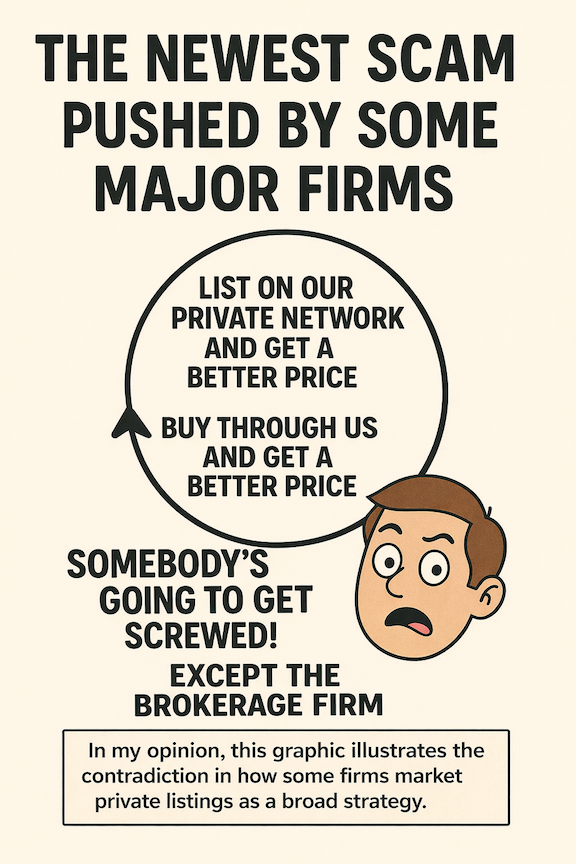
The Biggest Contradiction in the Entire Pitch
There is another contradiction that should be obvious to anyone listening carefully.
The seller is told:
“Keep your home on our private network and get a better price.”
The buyer is told:
“Work with us and buy from our private network before everyone else.”
Think about that for a second.
If the seller is truly getting the better result because access is restricted, then the buyer is not getting the better deal.
If the buyer is getting an inside advantage by getting access before the broader public, then the seller may not be getting full competition.
Both sides are being sold a benefit.
But both sides cannot be winning in the way the pitch suggests.
The side that consistently benefits is the side controlling the inventory, the access, and the narrative.
That is why large firms love private networks.
They create control. They create dependency. They create internal deal flow. They create leverage for the network owner.
But that does not make them better for consumers.
Sellers Need to Remember They Are Usually Buyers Too
This is another reason the whole thing is so shortsighted.
A seller today is often a buyer tomorrow.
So even if someone believes the private listing pitch helps them as a seller, they should stop and ask:
Do I really want to live in a market where homes are hidden? Do I really want inventory controlled by private gatekeepers? Do I really want access restricted when I become the buyer?
Because that same closed system being sold to you as an advantage on the listing side can be used against you on the buying side.
That is why private listing systems are a double-edged sword for consumers.
They may sound appealing in a listing presentation.
But as a market structure, they are worse for the public.
Don’t Hide Behind the Words “Fiduciary Duty”
One of the most frustrating parts of this debate is seeing firms defend private listings by wrapping them in the language of fiduciary duty.
They act as if this is simply the highest form of seller advocacy.
I disagree.
In my opinion, when private listings are sold as a general strategy without fully disclosing the downside, that is a breach of fiduciary duty.
Why?
Because fiduciary duty is not about giving a polished sales pitch. It is not about saying whatever sounds strategic. It is not about highlighting upside while leaving out downside.
It is about loyalty, honesty, and full disclosure of material facts.
If a seller is being told that private listings help preserve freshness, but not being clearly told that broad private exposure can still create hidden staleness, that is a problem.
If a seller is being told that private listings help maximize value, but not being clearly told that reduced exposure may reduce competition and weaken price discovery, that is a problem.
If a seller is being sold a strategy that also happens to benefit the brokerage by controlling inventory and deal flow, but that incentive is not squarely confronted, that is a problem.
And when those problems are not fully disclosed, in my opinion, that crosses the line from advice into breach.
This Is No Different Than Other Half-Truths in Real Estate
To me, this is no different than telling a buyer, “The seller pays the commission.”
That statement is often used because it sounds simple and convenient.
But it leaves out important reality.
It is a half-truth by omission.
That is exactly how much of the private listing pitch sounds to me.
Yes, there may be narrow situations where a limited strategy makes sense.
But when it is sold broadly, as though it is generally better for sellers, while omitting the downside, that is not full and fair disclosure.
That is a sales pitch built on omission.
And in my opinion, that is not consistent with fiduciary duty.
Real Fiduciary Advice Would Sound Very Different
Real fiduciary advice would sound more like this:
“If we keep your property off the open market, we may reduce exposure.” “If we reduce exposure, we may reduce competition.” “If we privately circulate the home broadly first, the market may still view it as previously shopped even if the MLS shows fewer public days.” “This strategy may help in certain situations, but it may also benefit our firm because we control the network and access.”
That would be honest.
That would be balanced.
That would give the seller a real chance to weigh the tradeoffs.
But that is not the way private listings are usually being marketed.
They are usually marketed as sophisticated, beneficial, and strategic without equal emphasis on the downsides.
That is exactly why I believe the fiduciary issue matters so much here.
The Industry Should Be Moving Toward More Transparency, Not Less
Real estate already has too many problems tied to opacity:
hidden incentives conflicts of interest confusing compensation structures information gaps gatekeeping
The answer is not more secrecy.
The answer is more transparency.
More open access. More visible market history. More honest price discovery. More consumer awareness. More accountability.
Private listing systems move us in the wrong direction.
They do not make the market healthier. They make it more controlled.
That is not progress.
That is regression dressed up as strategy.
My View After Decades in Markets
Before ShopProp, I built a financial firm that was later acquired. I spent more than 20 years in the financial markets. Then I spent 18 years running ShopProp as a managing broker.
All of that experience led me to the same conclusion:
Open markets are generally better for consumers than closed systems controlled by insiders.
Not because open markets are perfect.
But because they are more transparent. They encourage real competition. They improve price discovery. And they make it harder for powerful players to control information and shape the outcome behind the scenes.
Private listing systems do the opposite.
They narrow access. They hide exposure. They weaken transparency. And they are too often sold under a polished story that does not hold up under scrutiny.
Final Thought
Consumers should be very skeptical when they hear:
“Test the market privately first.” “Avoid days on market.” “Protect freshness.” “Get a better result off-market.” “Trust us, this is fiduciary.”
Because once a property has been broadly circulated through a private network, the market has already seen it.
The market has already reacted. The market has already formed an opinion. The market does not simply forget.
And when private listings are being sold as a general strategy without clearly stating the downside, in my opinion, that is a breach of fiduciary duty.
My view is simple:
Open markets help consumers. Private listing systems help gatekeepers.
That is why I believe private listings are a detriment to the market.