
Did ChatGPT Cost This Home Seller Money?
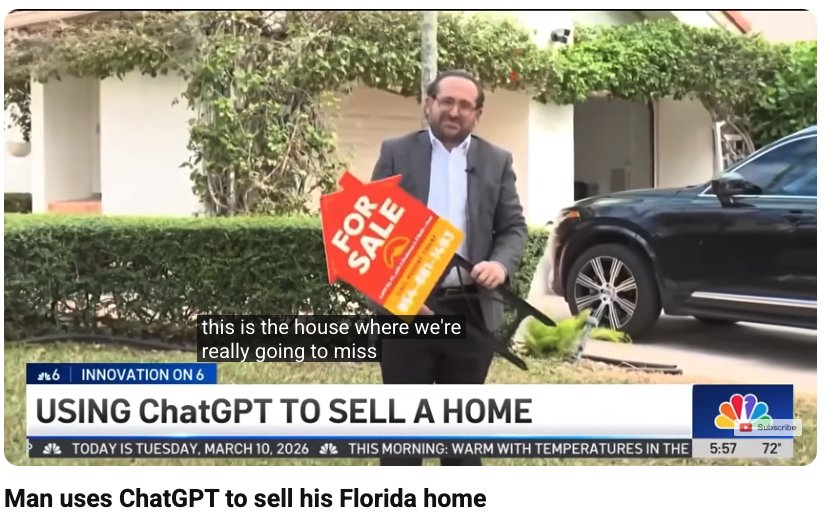
The NBC Miami story about a Florida man using ChatGPT to sell his home is going viral. But it may not tell the full story.
A new NBC Miami article about a Florida homeowner using ChatGPT to sell his home is getting a lot of attention. According to the report, the seller used ChatGPT for planning, pricing, marketing, showings, MLS guidance, and even help generating the contract. He also said he hired a lawyer to review the documents.
That raises a much bigger question:
Did ChatGPT actually save this home seller money, or could the structure of the sale have cost him money in the end?
The story presents AI as the hero. But if you look more closely, the seller still appears to have needed many of the same things serious sellers have always needed: MLS exposure, proper contracts, legal review, and transaction structure.
The real issue is not whether ChatGPT can be helpful. It can. The real issue is whether this seller used the structure that would maximize his final net proceeds.
- He still listed the home on the MLS
That part was smart. Broad exposure matters. The article says ChatGPT helped him get the home listed on the MLS, but it does not say who actually entered the listing, what that cost, or whether the seller was shown in the MLS as the direct contact instead of being represented through a broker.
That matters because the MLS is still the main system for putting a home in front of the widest pool of buyers. NAR says MLS-listed properties provide sellers increased exposure, and it describes MLS as offering pro-consumer benefits through broad market exposure and equal access to available properties.
With ShopProp, sellers can get MLS exposure, broker representation, and managing-broker-led oversight through free and transparent flat fees.
- The article says ChatGPT helped generate the contract
The article says the contract was generated with help from ChatGPT. That alone should make sellers pause. Real estate contracts are not just marketing copy. They are the legal backbone of the transaction.
Why rely on AI-generated contract language if standard industry forms already exist?
With ShopProp, sellers can use industry-standard forms as part of a process designed to protect them without unnecessary cost.
- He still hired a lawyer to review the documents
The article says he hired a lawyer to review the contract and legal documents, but it does not say what that review cost.
So the real question becomes this: if the seller still needed MLS access, still needed contract help, and still needed legal review, did he really create a better system, or did he just piece together services that could have been handled more efficiently through a company already built for this?
The bigger point the viral story misses
Since 2007, well before ChatGPT existed, ShopProp has been providing buyers and sellers with a better alternative to a pieced-together, do-it-yourself real estate transaction.
Instead of forcing consumers to stitch together MLS access, contract drafting, legal review, and transaction oversight on their own, ShopProp brings those pieces together through free and transparent flat fees, full-market exposure, and managing-broker-led oversight on every transaction.
That is the part consumers should understand.
This is not really a story about ChatGPT replacing real estate professionals. It is a story about a seller still needing many of the same protections and systems that already exist, while layering AI on top.
A better answer from ChatGPT may have been this:
Look for a company like ShopProp that can list your property in the MLS, provide broad exposure, use standard industry forms, offer broker oversight, and help you maximize your net without traditional overcharging.
The real goal is seller net
AI can be a useful tool. But the goal is not just to avoid paying a visible fee. The goal is to maximize seller net.
And this is where the broader market data matters. NAR’s 2025 profile says FSBO homes sold for a median of $360,000, versus $425,000 for agent-assisted sales. NAR also notes that FSBO homes often sell for less than other homes.
New academic evidence points the same way. A 2026 NBER working paper found that off-MLS sales were associated with lower returns, including a reported 0.29% lower return for off-MLS sales in one subsample discussed in the paper.
That does not prove every do-it-yourself seller loses money. But it should absolutely make sellers think twice before confusing “using AI” with “using the best strategy.”
If the seller still needed MLS access, still needed legal review, and still needed the structure that real estate professionals already provide, then the smarter question is whether a better brokerage model would have delivered a stronger result from the beginning.
That is where the real innovation is.
Not in a pieced-together do-it-yourself solution.
But in a model that combines technology, broad exposure, standard forms, and experienced oversight in one place.
Since 2007, ShopProp has helped buyers and sellers do exactly that.
Source
NBC Miami, “Man uses ChatGPT to sell his Cooper City home: ‘It exceeded our expectations’”. https://www.nbcmiami.com/news/local/innovation-on-6/man-uses-chatgpt-to-sell-his-cooper-city-home-it-exceeded-our-expectations/3778919/